


FREE DELIVERY ON ORDERS OVER £25
ALWAYS UP TO 70% OFF RRP
SIGN UP FOR OFFERS AND EXCLUSIVES
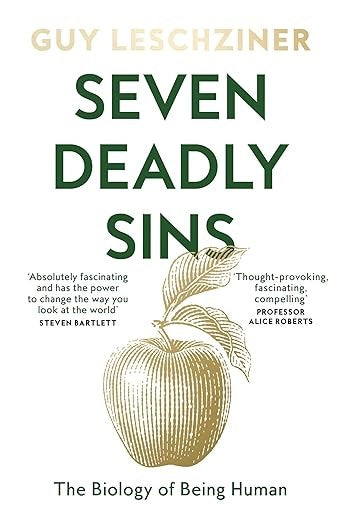
Seven Deadly Sins: The Biology of Being Human (Hardback)
Guy Leschziner (Author)
- £12.00
-
£22.00 - £12.00
- Unit price
- per
Save £10.00
Please hurry! Only 25 left in stock
10 customers are viewing this product
Couldn't load pickup availability
Free Shipping
Free standard shipping on orders over £25
Same day dispatch.
Free Returns
Learn More.

Gluttony. Greed. Sloth. Pride. Envy. Lust. Anger.
These are the seven deadly sins, the vices of humankind that define immorality, the roots of all evil in the world. Or so some believe.
But do these sins really represent moral failings, or are they simply human functions that aid us? Are they just the result of how our bodies, psyches, and brains in particular, are wired?
This new book by Dr Guy Leschziner, a professor of neurology and sleep medicine, explores the underlying nature of the seven deadly sins, their neuroscientific and psychological basis, their origin in our genes and crucially how certain medical disorders give rise to them.
Drawing on his clinical practice, we meet individuals whose physical and psychological conditions have given rise to these sins, where brain injury or other experiences have sparked ‘immoral’ actions. He explores how illness can simply expose what lies within us and investigates how the origins of these traits lie in evolutionary imperatives to preserve the wellbeing of the tribe. Perhaps, he suggests, these character traits are less of a moral question and more biological, which raises fundamental issues of responsibility and blame in the face of ‘sin’.
Combining cutting-edge science placed in the context of real-life experience with patients, the book reexamines where the boundaries between normal human nature, pathology and sin are drawn. And, most importantly, whether these hard-wired traits truly represent sin, or simply the intensity of our intrinsic desire to survive and thrive.
- Publisher: William Collins
- ISBN: 9780008615697
- Pages: 384
- Weight: 0.6
Guy Leschziner is a professor of neurology and sleep medicine at Guy’s and St Thomas’ Hospitals, and the Institute of Psychiatry, Psychology and Neuroscience, King’s College London. In addition to many academic papers and books, he is author of The Nocturnal Brain – Nightmares, Neuroscience, The Secret World of Sleep, and The Man Who Tasted Words. He has presented three series on neuroscience for BBC Radio 4 and World Service.
Related Products
Example product title
- £12.00
-
£22.00 - £12.00
- Unit price
- per
Save £10.00
Example product title
- £12.00
-
£22.00 - £12.00
- Unit price
- per
Save £10.00
Example product title
- £12.00
-
£22.00 - £12.00
- Unit price
- per
Save £10.00
Example product title
- £12.00
-
£22.00 - £12.00
- Unit price
- per
Save £10.00
Example product title
- £12.00
-
£22.00 - £12.00
- Unit price
- per
Save £10.00
Example product title
- £12.00
-
£22.00 - £12.00
- Unit price
- per
Save £10.00
Example product title
- £12.00
-
£22.00 - £12.00
- Unit price
- per
Save £10.00
Example product title
- £12.00
-
£22.00 - £12.00
- Unit price
- per
Save £10.00
Example product title
- £12.00
-
£22.00 - £12.00
- Unit price
- per
Save £10.00
Example product title
- £12.00
-
£22.00 - £12.00
- Unit price
- per
Save £10.00
Recently Viewed Products
Example product title
- £12.00
-
£22.00 - £12.00
- Unit price
- per
Save £10.00
Example product title
- £12.00
-
£22.00 - £12.00
- Unit price
- per
Save £10.00
Example product title
- £12.00
-
£22.00 - £12.00
- Unit price
- per
Save £10.00
Example product title
- £12.00
-
£22.00 - £12.00
- Unit price
- per
Save £10.00
Example product title
- £12.00
-
£22.00 - £12.00
- Unit price
- per
Save £10.00
Example product title
- £12.00
-
£22.00 - £12.00
- Unit price
- per
Save £10.00
Example product title
- £12.00
-
£22.00 - £12.00
- Unit price
- per
Save £10.00
Example product title
- £12.00
-
£22.00 - £12.00
- Unit price
- per
Save £10.00
Example product title
- £12.00
-
£22.00 - £12.00
- Unit price
- per
Save £10.00
Example product title
- £12.00
-
£22.00 - £12.00
- Unit price
- per
Save £10.00
- Choosing a selection results in a full page refresh.